One challenge of speech and language treatment is developing targets. There are only so many objects in a park, so I try to take one object and come up with multiple targets. Take this rock for example.
If /r/ is the target: ask your child to name the object as in "rock;" ask your child how it feels: "hard;" ask your child what color it is: "gray;" ask your child what shape it is: "square" or "rectangle;" ask your child to count the rocks: "one, two, three, four."
What other activities from just this one rock can you think of? Post below!
A source for Pittsburgh-based carryover ideas in the field of pediatric speech-language pathology
Showing posts with label Bird Park. Show all posts
Thursday, November 14, 2013
Abstract reasoning: what's missing?
I used to play the "What's missing?" game with my dad, and now you can play it at Bird Park. Look at empty spots in Bird Park, and asks your child "what's missing?" This stimulates abstract reasoning, which is particularly useful for children with cognitive disorders.
"What's missing in this parking lot?" Cars, trees, parking meters are all possible answers. What answers can your child think up? Post below!
Location:
Bird Park, Mount Lebanon, PA 15228, USA
Contests
Walking through a park in the fall and winter can become monotonous since the landscape may seem barren. To increase attention, I suggest having a contest to see who can spot something in Bird Park first. Make the target something relevant to your child's speech/language goals. For example,
"nest" for the /n/, /st/ sounds...
"hill" for the /l/ sound...
"squirrel" for two-syllable words, clusters. (Yes, there is a squirrel hiding there. Next time I will use the zoom feature on my camera.)
A variation on this game is not only to see who can spot the first next/hill/squirrel, but who can spot the most.
"nest" for the /n/, /st/ sounds...
"hill" for the /l/ sound...
A variation on this game is not only to see who can spot the first next/hill/squirrel, but who can spot the most.
Location:
Bird Park, Mount Lebanon, PA 15228, USA
Reading material
Even in the great outdoors, we can find reading material. Have your child read this plaque out loud to practice reading skills, stuttering strategies, articulation, etc.
Wednesday, November 13, 2013
Rhyming
Rhyming is important for children because it is a pre-literacy skill as it promotes awareness of sounds. See what rhymes your child can create. For example:
Bush: push
Roots: boots
Can: fan.
Cue your child to pay attention to the end sounds of the word.
Rhyming words can also provide practice for articulation of end sounds.
Bush: push
Roots: boots
Can: fan.
Cue your child to pay attention to the end sounds of the word.
Rhyming words can also provide practice for articulation of end sounds.
Verbs
Being at Bird Park means moving around. This is a great way to practice verbs and can be very motivating for children. See how many ways you and your child can move around, and have her narrate the process:
"Sit on the stump;" "We sat on the stump" (good practice for irregular past tense verbs!)
"Run around;" "We ran around" (also and irregular past tense verb)
"Smell the onion grass;" "We smelled the onion grass."
"Sit on the stump;" "We sat on the stump" (good practice for irregular past tense verbs!)
"Run around;" "We ran around" (also and irregular past tense verb)
"Smell the onion grass;" "We smelled the onion grass."
Location:
Bird Park, Mount Lebanon, PA 15228, USA
Adjectives; the "It feels" game
Building vocabulary often focuses on nouns, but adjectives are important also. Stimulate use of adjectives through the "It feels ____" game. Let your child feel objects at Bird Park and describe how they feel. Some ideas are:
Moss: "It feels _____" (soft, moist)
Mud: "It feels ____" (wet, sticky)
Grill: "It feels ____" (hot). (*Even in the off-season, I don't recommend actually touching the grill...just in case.)
Moss: "It feels _____" (soft, moist)
Mud: "It feels ____" (wet, sticky)
Grill: "It feels ____" (hot). (*Even in the off-season, I don't recommend actually touching the grill...just in case.)
Voice disorders
Treatment of voice disorders may vary by disorder, but a common part of treatment is "vocal hygiene." To over-simplify treatment, goals often include minimizing yelling and drinking water. Practice these techniques at Bird Park, and cue your child to talk in a lower volume and drink water during breaks. Resisting to raise one's voice in the outdoors can be a real challenge. Practice in natural activities at Bird Park, such as:
on the monkey bars,
and walking over a bridge.
For more information on pediatric voice disorders, visit http://www.asha.org/Publications/leader/2010/101123/Pediatric-Voice-Disorders--Evaluation-and-Treatment.htm
on the monkey bars,
and walking over a bridge.
For more information on pediatric voice disorders, visit http://www.asha.org/Publications/leader/2010/101123/Pediatric-Voice-Disorders--Evaluation-and-Treatment.htm
Location:
Bird Park, Mount Lebanon, PA 15228, USA
"L" words
Words containing the /l/ sound at Bird Park include:
"lamp"...
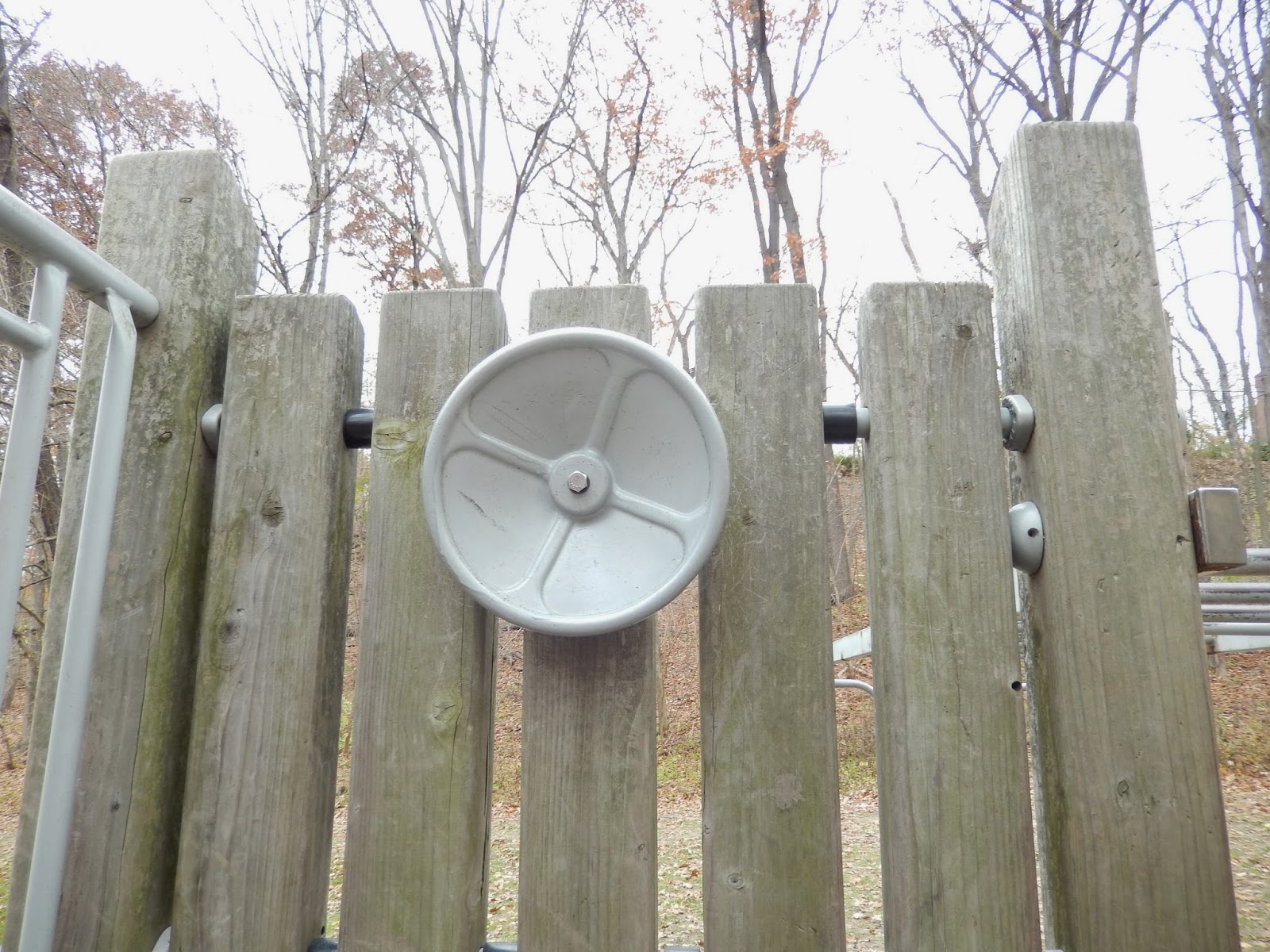
"steering wheel"...
"circle"...
and "pile of leaves."
A good tip for production of /l/ is to "make your tongue touch the roof of your mouth."
"lamp"...
"steering wheel"...
"circle"...
and "pile of leaves."
A good tip for production of /l/ is to "make your tongue touch the roof of your mouth."
Labels:
/l/,
Articulation,
Bird Park,
Speech
Location:
Bird Park, Mount Lebanon, PA 15228, USA
Clusters
Practice clusters (groups of consonants, such as "st" and "str") at Bird Park! Some targets include:
"sky"...
"stairs," or "steps"...
"field"...
"stream"...
"tracks"...
and "clover."
A good way to help your child produce clusters is to cue her to make every sound in the word. Model the sounds, even individually at first, as needed.
"sky"...
"stairs," or "steps"...
"field"...
"stream"...
"tracks"...
and "clover."
A good way to help your child produce clusters is to cue her to make every sound in the word. Model the sounds, even individually at first, as needed.
Wh- questions
Another way to stimulate speech and language is to ask wh- questions (who, what, when, where and why). Some examples include:
Who is the park in honor of?
What was your favorite part of the park?
When does the park close?
Why are the leaves changing color?
Who is the park in honor of?
What was your favorite part of the park?
When does the park close?
Where does the path lead?Why are the leaves changing color?
This activity can be done any time, but it is particularly useful at the end of the trip to review what the child has seen, to revisit targets, etc.
Wh- questions can also be used to gauge a child's understanding of language. For example, you may have the child note the difference between "when" and "where."
Stimulating speech and language
One way to stimulate speech and language at Bird Park is to discuss the scenery. I recommend comparing and contrasting the trees. Discuss leaves, height, shape, smell, etc.
Location:
Bird Park, Mount Lebanon, PA 15228, USA
Tuesday, November 12, 2013
Carryover for stuttering
One component of stuttering treatment is to speak slowly. This may be easy during therapy or in the classroom, but it can be challenging in a natural setting. A great way to practice this strategy at Bird Park is at the playground.
Let your child play, and see if she maintains the slow rate of speaking; cue as needed. (Tip: Remember that you don't need to correct every error.)
Relaxation at Bird Park for stuttering
Practicing speech can be hard work! Children who stutter may find that they need a break while at Bird Park practicing carryover. Stress, over-excitement, or fatigue can exacerbate stuttering. I recommend taking a seat at one of the many benches, and engaging in relaxation techniques.
These techniques generally involve deep breathing and relaxing one's muscles (especially the mouth muscles).
Building vocabulary
Vocabulary building is a great way to enhance language skills, and to practice sounds in new words. Things found in Bird Park that may build a child's vocabulary (depending on age) include:
"litter,"
"fungus,"
"grate,"
and "thistle."
"litter,"
"fungus,"
"grate,"
and "thistle."
Three syllable words
Three syllable words include:
can-o-py...
and cul-de-sac or turn-a-round. (Yes, I know this is pushing it! But Bird Park is a great place to build vocabulary!)
can-o-py...
and cul-de-sac or turn-a-round. (Yes, I know this is pushing it! But Bird Park is a great place to build vocabulary!)
Two syllable words
Often times we see a decrease in speech skills with longer words. Therefore, it may be helpful to practice two syllable words to decrease the potential for breakdown in carryover. Some two syllable words at Bird Park include:
nee-dles...
lad-der...
and pic-nic ta-ble (this is a two-for-one!).
nee-dles...
lad-der...
and pic-nic ta-ble (this is a two-for-one!).
/v/ is not just for Veronica
The /v/ sound can be difficult to practice because it is not as common as, for example, /r/. But on just one walk through Bird Park, I found three /v/ targets:
ivy...
pavilion...
and vehicle.
A /v/ sound may be substituted by another sound. In this case, I recommend that one models the /v/ sound in words while putting special emphasis on the "vuh;" have the child imitate. A good cue is to remind children to put their front teeth on their lower lip when making the sound, then demonstrate the maneuver.
ivy...
pavilion...
and vehicle.
A /v/ sound may be substituted by another sound. In this case, I recommend that one models the /v/ sound in words while putting special emphasis on the "vuh;" have the child imitate. A good cue is to remind children to put their front teeth on their lower lip when making the sound, then demonstrate the maneuver.
Labels:
/v/,
Articulation,
Bird Park,
Speech
Location:
Bird Park, Mount Lebanon, PA 15228, USA
Subscribe to:
Posts (Atom)