Showing posts with label /l/. Show all posts

Wednesday, January 22, 2014

/l/ in the final position

Practice the /l/ sound with these words:

"apple," and ...


"table."


To practice /l/ at the phrase level, have your child name the different types of apples at the store.  Simple targets may include "red apple," and "green apple."  More complex targets may include "granny smith apple," and "gala apple."  Printed names of the apples on the signs may be helpful for higher level naming.

To practice /l/ at the sentence level, have your child tell you what activities she can do at a table.  Targets may include, "I eat at the table," "I color at the table," and "I talk at the table."

To practice /l/ in conversation, ask you child how to set the table for dinner.  Targets may include, "I put plates on the table.  Then, I put glasses on the table.  Next, I put napkins on the table...."

To cue for the /l/ sound, remind your child to touch the tip of her tongue to the top of her mouth (specifically to touch ridge that is behind her upper teeth).  Some techniques for /l/ practice advocate dipping a Q-tip in a tasty substance, then rubbing it on the ridge; when the child makes the /l/ sound, she will taste the flavor.  Apple juice or cider may work.  She can practice saying  "apple" while also tasting it.  Clever!

Friday, January 10, 2014

/l/ in the initial position

Practice the /l/ sound with these words:

"lemon" and...

 "lime."


To practice phrases, ask you child to describe the fruits.  Targets may include, "yellow lemon," "green lime," and "small lemons/limes."

To practice sentences, ask have your child to describe the fruits in full statements.  Targets may include, "Limes are green," "Lemons are yellow," and "I see stickers on the limes."  It is all right if your child isn't familiar with these fruits; it will give her a chance to explore.

To practice conversation, compare and contrast the fruits.  Targets may include, "Lemons are yellow.  Limes are green.  Some limes are yellow.  They are all small."  Another way to practice conversation would be to ask your child what foods are made with lemons and/or limes (e.g. pies, Italian ice).  Or, ask her if she thinks lemons and limes have more in common with fruits or vegetables.

To cue for the /l/ sound, remind your child to touch the tip of her tongue to the top of her mouth (specifically to touch ridge that is behind her upper teeth).  Some techniques for /l/ practice advocate dipping a Q-tip in a tasty substance, then rubbing it on the ridge; when the child makes the /l/ sound, she will taste the flavor.  Lemons might be a bit harsh for this, but lime juice may work.  She can practice saying "lime" while also tasting it.  Clever!

Thursday, November 14, 2013

Contests

Walking through a park in the fall and winter can become monotonous since the landscape may seem barren.  To increase attention, I suggest having a contest to see who can spot something in Bird Park first.  Make the target something relevant to your child's speech/language goals.  For example,


"nest" for the /n/, /st/ sounds...


"hill" for the /l/ sound...


"squirrel" for two-syllable words, clusters.  (Yes, there is a squirrel hiding there.  Next time I will use the zoom feature on my camera.)

A variation on this game is not only to see who can spot the first next/hill/squirrel, but who can spot the most.

Wednesday, November 13, 2013

"L" words

Words containing the /l/ sound at Bird Park include:

"lamp"...


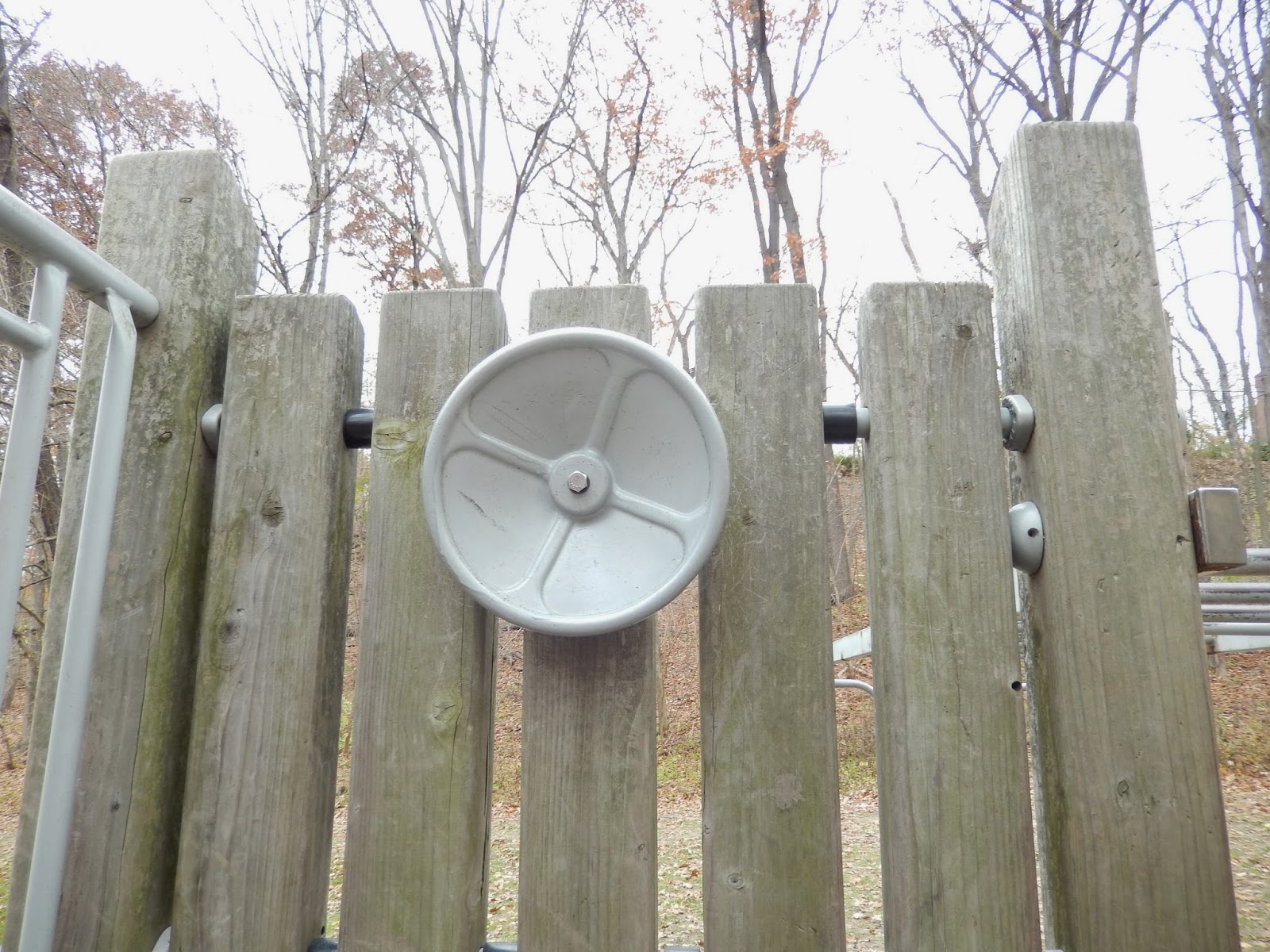
"steering wheel"...


"circle"...

and "pile of leaves."

A good tip for production of /l/ is to "make your tongue touch the roof of your mouth."