Monday, March 24, 2014

CVC (consonant-vowel-consonant words)

When children are between the ages of 1 and 2, they can usually say between 20 and 50 words that are intelligible to familiar listeners.  They move from saying things like "ba" for "bottle" (CV or consonant-vowel word) to things like "baba" for bottle (CVCV or consonant-vowel-consonant-vowel word).  The next step is to encourage them to develop age-appropriate speech is the CVC word, or consonant-vowel-consonant word.  This structure is important because it "closes" the syllable/word; to put it another way, it ends the word with a consonant instead of a vowel, which is closer to appropriate speech.

Many words that children first acquire are CVC words: mom, dad, cat, dog, ball, car, cup, feet, nose, etc.  Thus, it is important to reinforce this word structure.

A good place to practice CVC words that are commonly acquired by children is by visiting a cat show.  I went to one in Pittsburgh last month, and thought it was a great learning tool for outside the home.  For example, you may want to teach your child to say "cat" in the CVC format; she may produce the word cat, but it may come out as "ca" in the CV form.  First, start by modeling the word "cat."  Say it over and over.  Make sure she is paying attention, and looking at you.  You may even want to start with some pre-teaching at home, by looking at pictures of cats.  When you see each one, say "cat."  Point to a picture and ask her what it is.  If she says "ca," then repeat it again, with emphasis on the last sound.  Then, have her say it again.  Praise her for her efforts.  Practice makes perfect, so please be patient.  Once you arrive at the cat show, point to each cat and have her label it; labeling is an early skill that children learning to talk use.  This will give her practice outside the home.  If she is having difficulty, say the word for her, then say the word with her, then finally ask her to say the word by herself.  Again, this may take time but it will pay off.

 
Image retrieved from http://www.businessexpocenter.com/event/catshow.

I had planned this activity for a second upcoming cat show that was planned for the Iceoplex at South Pointe, but it was canceled.  If anyone knows of upcoming cat shows, please post below so others will be able to use this activity.

With young children, I recommend targeting the same word over and over at first in order to simplify the task, and to provide more practice.  However, there is nothing wrong with addressing other targets.  There are plenty of other CVC words that are commonly used by children at cat shows, including:

"nose"

Image retrieved from http://content.time.com/time/photogallery/0,29307,1671582,00.html.

"ball"


Image retrieved from http://www.vetwest.com.au/pet-library/exercise-and-nutrition-for-your-cat.

"feet"

Image retrieved from http://www.catster.com/lifestyle/5-cat-facts-cats-paws.

"leg"


Image retrieved from http://www.catfacts.org/legs-cat-facts.htm.

"mom"

Image retrieved from http://boninfamilyadventures.blogspot.com/2012/06/standing-guard.html.

and believe it or not, "dog."

Image retrieved from http://www.petparadisetx.com/.

*Tip: CVC words that contain sounds that are easily seen on the face are usually easiest to teach.

Pittsburgh dialect/Pittsburgh speech/Pittsburghese; Code Switching

Pittsburgh dialect, sometimes called Pittsburgh speech or Pittsburghese, is a valid dialect studied by researchers.  Like any other dialect, it includes words, sounds and grammatical patterns that are largely specific to one region.  It is a way of speaking that is accepted, much like the Boston "R," New Yorkers' use of the "aw" sound as in "cawfee tawk" (coffee talk) and the prolongation of vowel sounds in the south.

 
Image retrieved from http://www.bravomusicgifts.com/enat.html.

It is expected that a child living in Pittsburgh will exhibit some aspects of the Pittsburgh dialect.  According to sociolinguists (http://pittsburghspeech.pitt.edu/PittsburghSpeech_FAQ.html), this is pleasing to some people as it may demonstrate that one is proud of her hometown; this may be embarrassing to others as it may be interpreted as not "speaking correctly."

Some parents may be conflicted or uncertain about how they feel.  If this is the case for you, then what I recommend is to teach your child about "code switching."  Code switching is the idea that we as people can use different language varieties depending on who our communication partners are, or what the communication setting is.  For example, an adult may use standard American English while at work, but use a New England dialect, New York City dialect or African American English when at home or with friends.  The point is that a person can switch back and forth between use of dialects and be fluent in each one.  The advantage of this is that children are given the tools to use speech and language in more than one way.

Image retrieved from http://www.dcski.com/forum/78864

If you are interested in having your child be able to code switch, then have a discussion with her.  Explain to her that there is more than one acceptable way to speak, and that you suggest she be proficient in more than one way so that she has the tools to speak however she would like.  Chances are, she is probably already somewhat adept at code switching.  Children have many communication partners, and the media also shows us varying ways of speech and language.  Thus, she has probably already been exposed to different ways of speaking.

According to sociolinguists, there are three major indicators of Pittsburgh speech: words, grammar, and vowel pronunciation.

The easiest way to start practicing code switching is to talk about how different words can mean the same thing.  Just as there are synonyms for the word "happy" including "cheerful," "elated" and "glad" (which are all acceptable!), there are also other ways of saying things that are different from the Pittsburgh dialect.  Explain to your child that "gumbands" are also called "rubberbands" and that some people say "clean up" instead of "redd up."  This may very well prove fascinating to your child.  Other words from Pittsburgh dialect include "slippy" with its counterpart being "slippery" in Standard American English, and "nebby" meaning "nosy."

In terms of grammar, what tends to make Pittsburgh speech stand out is the omission of the "to be" verb.  Someone may say "This needs washed," rather than "This needs to be washed."  Again, explain to your child that there is more than one way to construct a sentence; people in Pittsburgh may say "This needs fixed" whereas people in the mid-west may say "This needs to be fixed."

As for vowel pronunciation, this may be the hardest as it is probably the most habituated.  Sometimes the older we get, the harder it is for us to change our pronunciation as we may lose our ability to decipher subtle differences in sounds.  According to sociolinguistics, Pittsburghers often pronounce the "aw" vowel as "ah."  Thus, "down" may be pronounced as "dahn" and "not" may be pronounced as "nawt."

So, how can you and your child practice code switching?  One way that may facilitate understanding how to switch codes is to play dress up.  When she is wearing a Steelers jersey or Pirates cap, then she can practice her Pittsburgh dialect.  When she is wearing something else (e.g. a fluffy dress or a cowboy hat) then she can practice Standard American English.  You can even model how to contrast the speech and language by putting on the hats yourself.  Explain to her that when you are wearing the cap, you speak using words like "gumbands" and "dahntahn," but when you wear the cowboy hat, you speak using words like "rubberbands" and "downtown."  Once she is more proficient, switch the hats on and off and see how fluent you and your child can be.  Then, practice outside the home.  When you are at Pittsburgh institutions you may want to practice Pittsburgh speech; this would be a great time to teach your child about Pittsburgh history and expose her to other elements of the Pittsburgh dialect.  When you are outside of the area (maybe when visiting the grandparents) you can practice Standard American English.  For example, if it is icy outside your home, you may ask her child how the ice would feel if she walked over it in Pittsburgh speech; cue her to say, "It would feel slippy."  Then, if it is icy outside her grandparents, ask her how they would say the ice feels; cue her to say, "It would feel slippery."  Likewise, if the streets are snowy in your neighborhood, ask your child what needs to be done and ask her to use Pittsburgh speech.  Her reply may be along the lines of, "It needs plowed."  Then, ask her how someone outside of Pittsburgh might say it.  Her reply should be, "It needs to be plowed."

*Tip: Please remember that while code switching is useful, it is not essential.  Dialects are recognized as legitimate speech and language variations specific to certain groups/regions.

For more information on Pittsburgh speech/Pittsburghese, please visit this link written by researchers based in Pittsburgh: http://pittsburghspeech.pitt.edu/index.html

Friday, March 21, 2014

Prepositions; Trains

Prepositions are words that usually precede nouns and pronouns; they express the relationship of nouns/pronouns to another word/element in the sentence (generally in terms of time and space).  There are many prepositions, some of which include:

about, above, across, after, against, along, among, around, at,
before, behind, below, beneath, beside, between, beyond, but, by,
despite, down, during, except,
for, from,
in, inside, into,
like,
near,
of, off, on, onto, out, outside, over,
past,
since,
through, throughout, till, to, toward,
under, underneath, until, up, upon,
with, within, and without.

Prepositions (and prepositional phrases) are important for children to learn because they make language more descriptive.  Also, better proficiency with proper grammar leads to stronger writing skills.

When first learning prepositions, it is helpful for children to begin to conceptualize them in terms of space/location.  I suggest visualizing a house, and relating prepositions to a house: "The sky is above the house;" "The pipes are beneath the house;" "The children are inside the house."

To make grammar more concrete, I suggest encouraging your child to create sentences with prepositional phrases at locations with visual interest.  As with the house example, start with prepositions indicating space.  For example, watch trains go by at Station Square.

 
 Image retrieved from http://www.flickr.com/photos/pghbuccos/8282046777/

Have your child describe the trains using prepositional phrases about space.  Targets may include:

"The train is on the tracks," (this preposition describes the relationship of the train to the tacks in terms of space); cue your child by asking, "What is the train on?" if she has difficulty creating the sentence.

"The engineer is inside the train," (this preposition describes the relationship of the engineer to the train in terms of space); cue your child by asking, "Where is the engineer?"

Next, ask your child to describe the trains using prepositional phrases describing time.  Targets may include:

"The train will come back in one week," (this preposition describes the relationship of the train to one point in time); cue your child by asking, "When do you think the train will come back?"

"The train passed us at 6:00," (this preposition also describes the relationship of the train to one point in time); cues your child by asking, "When did the train pass us?"

Thursday, March 20, 2014

First day of spring; adverbs

I've been wanting to post on adverbs for a while (I lead a very exciting life, don't I?!).  An idea finally came to me today: an activity based on the first day of spring.  Adverbs modify verbs, adjectives and other adverbs.  Adverbs usually end in "-ly" and answer the question "how?"  Cueing your child to use adverbs is important because they serve to convey more information in a sentence, leading to more complex language/vocabulary usage.

To prompt your child to use adverbs, ask your child what will happen now that it is spring.  Answers may include, "Leaves will grow slowly,"  "The wind will blow softly," "Flowers will bloom beautifully," "The sun will shine brightly."  If your child simply states, "Leaves will grow," then prompt her to use an adverb by asking her "How will the leaves grow?" since adverbs answer the question "How?"

This task is also helpful for reasoning.  If you need some inspiration, go to one of Pittsburgh's parks or your own backyard and look at the barren landscape.  Ask your child how it will change now that spring is here.

Here is a nice shot of Mellon Park Walled Garden:

 
Image retrieved from http://pittsburghparks.wordpress.com/2011/12/01/pittsburgh-parks-conservancys-award-winning-gardens/

Stuttering; Van Riper Approach Continued

In my last post, I highlighted one component of Charles Van Riper's approach to stuttering treatment.  It involved modifying stuttering and included the strategies of cancellation, pull-out and preparatory set techniques.  Now, I would like to address the other components of Van Riper's stuttering modification program, often referred to by the acronym MIDVAS.

Motivation:  The child should be motivated to seek therapy and participate in it.  Caregivers should help children understand the therapy process and share positive information.

Identification: The child should identify her individual stuttering moments in order to build awareness.

Desensitization: The child's "negative" emotions regarding stuttering are addressed to reduce the stress associated with stuttering.  Techniques may include relaxation and stuttering on purpose.

Variation: The child will modify her stuttering.  This may involve using a word repetition ("book-book") instead of a sound repetition ("b-b-b-book").  This is meant to increase a child's control over stuttering/speech.

Approximation: Modifying the child's speech in order to decrease stuttering and increase fluency.  The strategies of cancellation, pull-out and preparatory set techniques are discussed in the previous posting.

Stabilization: The child gains self-confidence and the ability to monitor her own speech/use therapy strategies independently.

Next, I would like to address how parents and other caregivers in the Pittsburgh area can work on these components.  In terms of motivation, J. Scott Yaruss (a Ph.D. level SLP) notes that we should envision goals more broadly, and explain to children that the purpose of speech therapy is to increase communication (not simply to eliminate stuttering).  Here is a link to the piece Yaruss wrote, "Why School-age Children Who Stutter Aren't Motivated for Therapy": http://www.speechandlanguage.com/stories-from-the-field/why-school-age-children-who-stutter-arent-motivated-for-therapy.  One way to increase motivation would be to find out from your child what they are having trouble with in terms of communication.  Is it talking on the phone?  Reading aloud?  Speaking with friends at recess?  Whatever it is, that should be used as a target in therapy.  So, if your child finds that she stutters more on the phone and this then decreases her ability to communicate, target having her speak on the phone.  She can start by calling a family member, and then progress to more complex calls to friends, acquaintances, and institutions.  Here are some tips for people who stutter regarding telephone usage from The Stuttering Foundation: http://www.stutteringhelp.org/using-telephone

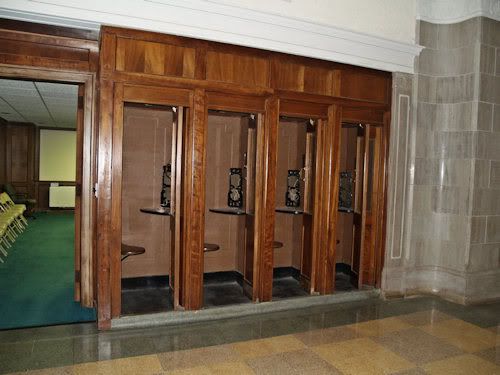
Since cell phones are probably most popular, I recommend having your child practice phone usage at a location she feels comfortable in.  This may be her bedroom, on school grounds, at a quiet cafe, etc.  Once she is ready to broaden her horizons, a great Pittsburgh place to practice would be in a phone booth.  The Citizens Bank Building at 525 William Penn Place has some old-fashioned telephone booths much like the one pictured below.
Image retrieved from http://dougdawg.blogspot.com/2009_06_01_archive.html.

In terms of identification, have your child identify moments of stuttering during a task she is invested in.  If your child wants to have more fluent speech when reading aloud, ask her to read something she is interested in, then discuss with her the particular types of stuttering she encounter (allow her to lead the conversation).

"Pittsburgh Magazine" is an excellent source of news and human interest that may provide a good starting point for children of middle school and high school age.  Magazines are great for oral reading because their stories are often concise and are filled with a lot of visually interesting pictures.

 
Image retrieved from http://slickdeals.net/localdeals/pittsburgh/.

For desensitization, the goal is to reduce anxiety about speech.  One technique is relaxation, whereby you may instruct your child to pretend her body is a melting ice cube; the idea is to let her body ease out of tension.  Practice this with her regularly so that it comes naturally; the body and mind should be relaxed.  Another technique is to ask your child to stutter on purpose.  Stuttering on purpose can signal to her that she can be in control of her speech, and can also demonstrate that even when she stutters, nothing "bad" will happen.

To encourage your child to engage in relaxation techniques while out in the real-world with all of its distractions, pick a public place that is welcoming.  According to Pittsburgh Magazine, "Knit One" is the best yarn store to visit if you enjoy crafts and talking with friendly people, or just sitting down and soaking up the scenery.  I recommend visiting the Buhl Planetarium at the Carnegie Science Center. 


Image retrieved from http://www.carnegiesciencecenter.org/planetarium/buhl-planetarium-skywatch/

To practice variation, review with your child different ways to stutter.  There are part word repetitions ("wh-wh-where"), sound prolongations ("sssssister") and interjections ("I, um, you know, want to see a movie") to name a few.  Try these out at home during preferred activities so that your child will continue to be motivated throughout the whole process.

You can help your child with the approximation stage by cueing her to use cancellations, pull-outs and preparatory set techniques.  (See previous post for detail.)

Finally, aid your child with the stabilization phase by praising her for monitoring her speech, whether she is successful or not.  Also, try to keep her motivated by reminding her of the big picture and reinforcing positive self-esteem.